
You know that magical feeling of being a kid and forgetting the world around you because you’re so immersed in a game or a story that it becomes your reality?
Would you ever imagine that, as an adult, you would be advocating for a better world by co-designing a game and a story for other kids to play? Well, I certainly wouldn’t. Yet, somehow, it happened when I was lucky enough to join the Youth Technical Advisory Board of Sustainaware.
When most people hear “Climate Crisis”, global warming usually comes to mind, along with a few generic images of endangered species. It’s easy (and dangerous) for these mental pictures to lead us into a sense of powerlessness, and maybe even a quiet comfort in feeling “not responsible”, as if action belonged only to environmental engineers or clean-energy specialists. But when we truly dare to dive into the information – especially the uncomfortable parts – and begin to understand how complex, multifactorial and deeply interconnected this issue is, it becomes much harder to ignore our own power to act.
That realisation is scary.
But it is also incredibly empowering. And that’s exactly what fascinated me about Sustainaware: the way it made it crystal clear that staying still is a choice, and staying active is also a choice.
Even though climate issues are not directly connected to my academic background, they have always been a priority in my personal interests when I was younger — from small town-level initiatives to the way I argued very convincingly (some would say “blackmailed”) my parents into recycling until it became a lasting family habit. So when I heard about the possibility of joining a panel of young activists from different backgrounds to build something as meaningful as an online escape room to tackle climate change, my first thought was: “This is wonderful. I really want to be part of it!” My second thought, however, was a bit more complicated: “This is wonderful… I really want to be part of it… But I don’t think I have anything big enough to offer.”
Advocacy is an old friend of mine. I’ve been involved in NGOs since a young age and, more specifically, I have been advocating for Public Health throughout my whole academic path, during both my Bachelor’s and my Master’s in Psychology. Even though the environment is such an important part of health, my focus has always been on mental health access and its intersection with physical health. So stepping into a field where I didn’t feel fully knowledgeable was, of course, a little intimidating. But I am so glad I did.
The more I studied the intersection between the climate crisis and psychological science, the more fascinated I became. I developed a genuine curiosity and, along the way, shared what I knew and learned so much from others who were eager to exchange ideas, insights and perspectives. This whole experience reminded me that every field has something valuable to bring to others as long as we are willing to offer it. There is no such thing as useless knowledge; there are simply more useful perspectives on which to apply it.
What started as something scary grew to a very exciting. After knowing that I was selected for the advisory board, late spring 2024, I had the summer to study about this, and it was addicting, also empowering to understand how this project was giving us so many resources to make a difference. I started learning about a concept I briefly learned in college – Ecoanxeiety, defined by the American Psychological Association (APA) as the …… Even though APA recognised this term in 2017, it goes back to the 90s, showing how this fight has been going for more than we can imagine. After this self-dive, sustainaware provided us with monthly meetings where we had the chance to learn about different topics, share our knowledge, challenge it, improve it, exchange it and build an inspiring network of perspectives and people. We explored not just climate but mainly HOW to act on it, which was an extremely hands-on perspective and taught us so many things that could be applied to so many spheres of our professional and personal lives. The process of designing an escape room involves understanding gamification, co-design and such concepts, which for me ended up being highly helpful to my master’s thesis as well, where I was co-designing a platform to support the well-being of families with genetic syndromes (most of these syndromes are severely impacted by a nefast environment as well, everything is truly connected).
What started as something scary quickly grew into something very exciting. After learning that I had been selected for the advisory board in late spring 2024, I spent the summer diving deeper into this field. I began exploring a concept I had only briefly encountered in college: eco-anxiety, which the American Psychological Association (APA) defines as “a chronic fear of environmental doom.” This anxiety can include feelings of worry, helplessness, and distress about the state of the environment and the future of the planet, often affecting daily functioning and well-being. Even though APA formally used the term in 2017, its origins trace back to the 1990s, showing that this fight has been ongoing far longer than we often imagine.
After this self-directed deep dive, Sustainaware provided us with monthly meetings where we could learn about different topics, share our knowledge, challenge it and ultimately build an inspiring network of perspectives and people. We explored not only climate issues but, more importantly, how to act on them, which was a hands-on approach that taught us lessons applicable to many spheres of both professional and personal life. For instance, the process of designing an escape room involved understanding gamification, co-design, and other related concepts. This ended up being extremely helpful for my master’s thesis as well, where I was co-designing a platform to support the well-being of families living with genetic syndromes. Sadly and ironically, many of these syndromes are severely impacted by harmful environmental factors, showing how everything is truly connected.
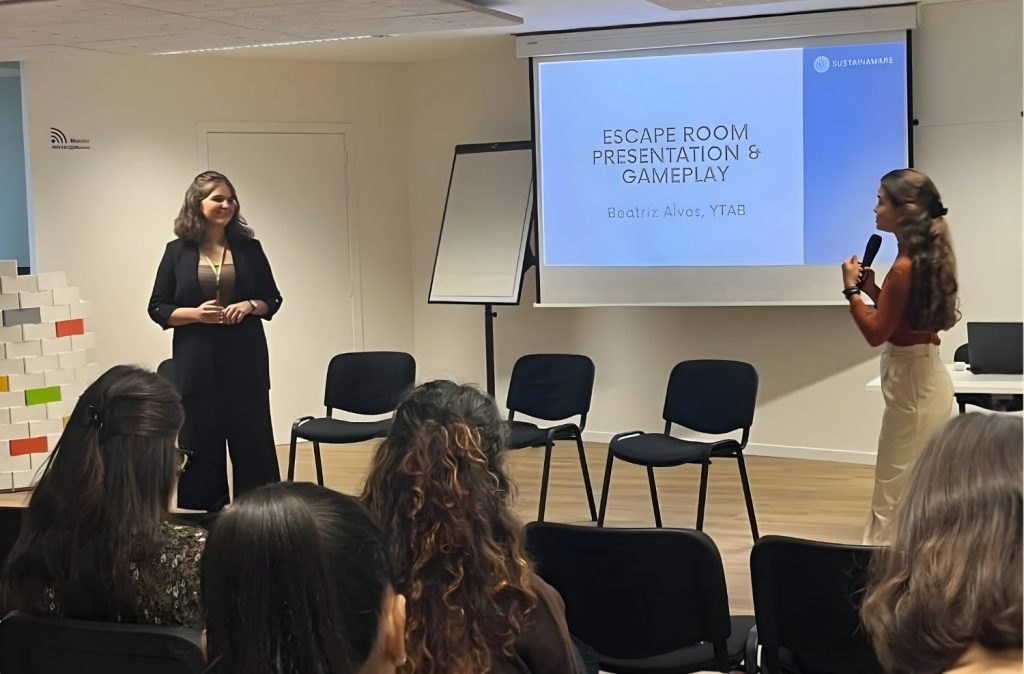
After many months of dedication, it was an incredible feeling to see the faces I had only met online take real shape when we met for the final event in Brussels on the 3rd and 4th of November for Intersections for Impact: A Forum on Health, Environment & Education. These days, filled with incredible guests, panels, and inspiring speeches, culminated in the presentation of our online escape room, which I had the honour of personally presenting before we invited the audience to experiment. Seeing them discuss the challenges we had created and noticing the childlike sparkle in their eyes made me certain that something meaningful had been achieved during this time. These days marked a temporary goodbye to a project with enormous potential to continue living through its people, resources, and the seeds of inspiration planted throughout its course.
You know that magical feeling you had as a kid — wanting to change the world because a story or a game made you believe it was possible?
Sustainaware made that magic real again.
Thank you.
Beatriz Alves


